

Barbarity and Civilization: Explaining Wanton Violence in the Conduct of War
How do futile bombing campaigns fit into the theory of war?

“If we find that civilized nations don’t put their captives to death, don’t destroy city and countryside, it is so because the intellect is more mixed into their practice of war and has taught them more potent means of applying violence than these raw expressions of instinct.”
-On War, Book I, Chapter 1
The ongoing fruitless bombing campaign against Iran gives us a good occasion to ask: how do we explain this kind of unproductive violence in war? To begin to answer this question, let us turn to a lesser-remarked-on part of On War, in which Clausewitz seeks to explain the differences in conduct between wars by civilized and uncivilized nations and the tendencies of violence in war.
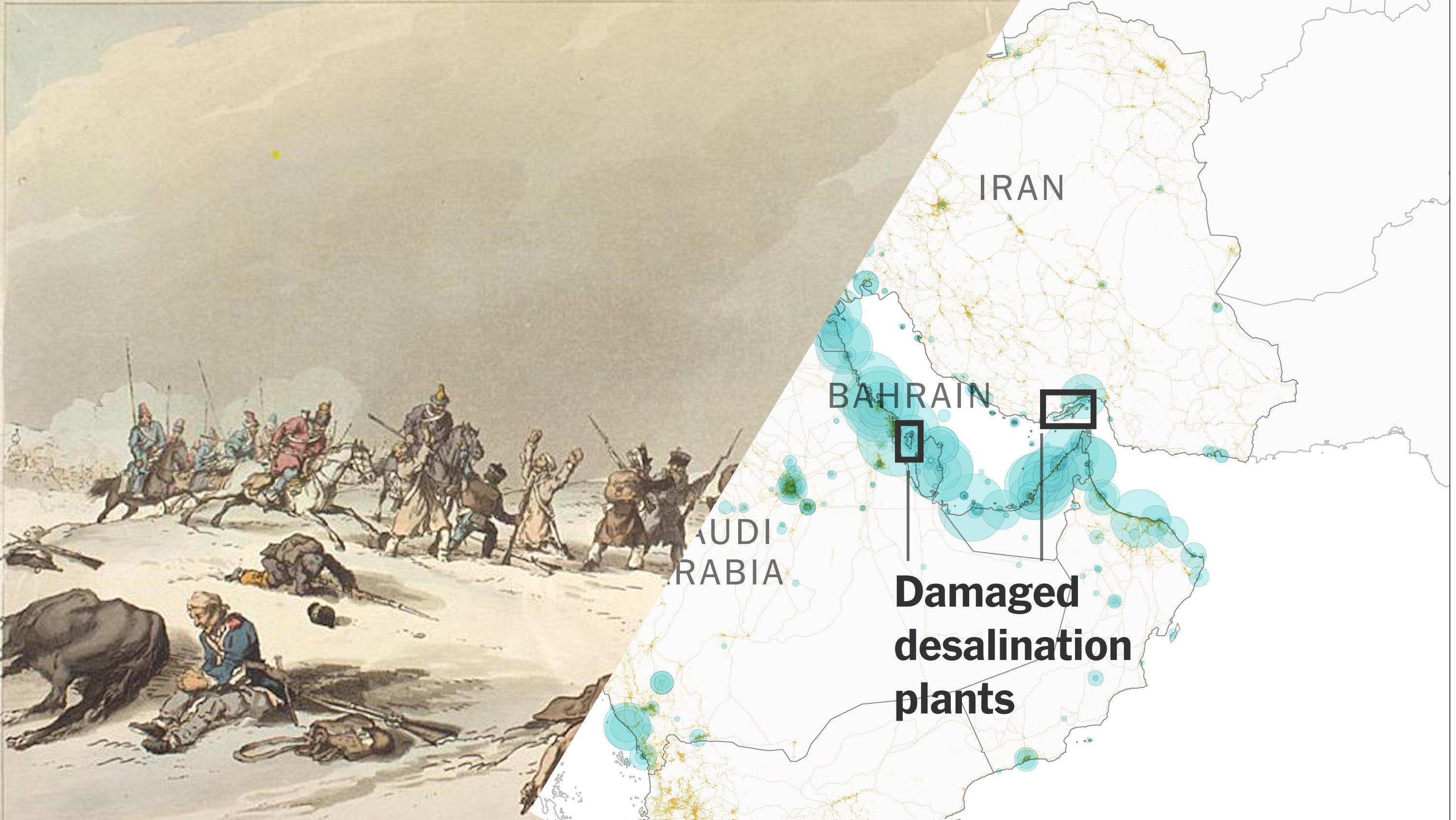
In the first chapter of On War, Clausewitz begins by examining war in the abstract, as a pure concept. The third section of this chapter is entitled Äußerste Anwendung der Gewalt (The Apex Application of Violence) and in it he argues that the nature of war drives both sides to the extreme, “Since the application of physical violence to its fullest extent doesn’t preclude the participation of the intellect in any way, whoever operates this violence recklessly, without sparing lifeblood, will obtain a preponderance—if his opponent does not do the same. Through this, each side sets the law for the other, and so the two escalate to the extreme” (my translation). He explicitly disclaims the idea that the advancement of the art of war means finding a way to fight with less violence. Clausewitz insists “Thus must the matter be thought of. It is a useless—even preposterous—effort to leave out the barbarous element of war because of aversion to it.” From here, I will provide the remainder of the section:
If the wars of civilized nations are much less gruesome and destructive than those of the uncivilized, this is due to the social conditions both within the states and between them. It is from these conditions and relationships that war comes forth, and through them it becomes conditioned, constricted, and reduced; but these things don’t belong to war itself, and only represent to it a given. A principle of reduction cannot be brought into the philosophy of war itself without committing an absurdity.
Conflict between people really consists of two different elements, the hostile feeling and the hostile intent. We have chosen the latter of these two elements as characteristic of our definition because it is the universal one. One can’t imagine even the rawest, most passionate, borderline-instinctual hatred without a hostile intention. On the other hand, there are many hostile intentions that are accompanied by absolutely no—or at least no ruling—feelings of enmity. Among uncivilized nations, intentions are ruled by the heart, whereas amongst civilized nations, the intentions belong to the mind; but this difference does not lie in the essence of barbarity and civilization themselves, but rather in the accompanying circumstances, institutions, etc. This difference is therefore not necessary in every case, but rather it only governs in the vast majority of cases. In a word: the most civilized nations can also be fervently enflamed against one another.
One can see from this how untrue it would be to reduce the war of the civilized to a mere act of reason by the government, and to think of it as more and more released from all passion, so that at last the physical masses of fighting forces aren’t really needed, but only their proportions, in a kind of algebra of action.
Theory had already begun to move in this direction until the phenomena of the last war taught it better. Since war is an act of violence, it necessarily belongs to the heart as well. While it does not come from the heart, it attributes more or less to it, and this “more or less” depends not upon the degree of civilization, but rather the importance and duration of the hostile interests.
If we find that civilized nations don’t put their captives to death, don’t destroy city and countryside, it is so because the intellect is more mixed into their practice of war and has taught them more potent means of applying violence than these raw expressions of instinct.
The invention of gunpowder and the ever progressing development of the firearm already adequately demonstrate that the inherent tendency of the concept of war to the annihilation of the opponent has not, in fact, in any way been destroyed or diverted by the progress of civilization.
Therefore, we repeat our proposition: war is an act of violence, and there are no internal limits to the application of it; as each side sets the law for the other, a reciprocal effect occurs, which, in the conception, must lead to the extreme.
Progress and Violence
This section frankly discussing “savage” and “uncivilized” peoples is somewhat shockingly dated to the modern reader, all the more so since On War contains very little use of similar terms. On the one hand, Clausewitz was likely responding to claims made by Georg Wilhelm von Valentini, who had argued (based upon his experiences fighting against the Turks) that wars against savage peoples were intrinsically different from those between civilized nations. Clausewitz wrote to Gneisenau on Valentini’s book, in typically sarcastic style:
Valentini has allowed the third part of his Art of War to come out, which includes the war with the Turks. I have still not read the earlier ones for good reasons; this part, when one looks through the table of contents, appears properly splendid, but when one gets to the book itself, it is nothing of substance. However, I nevertheless recommend it to Your Excellency, since there are some very interesting fragments contained in it regarding the campaigns of 1810 and 1811; one can see from them that war against the Turks is now no longer much different from other wars (disregarding that the book takes the opposite position)…1
In On War, however, Clausewitz contended that war remained essentially the same throughout all of history, only modified in its form by the particular societies and circumstances that produce each individual war—for his approach to be valid, it was necessary to explain why wars of “uncivilized” peoples were no exception to the theory.
More fundamentally, however—much like for 20th century authors—the biggest question at hand for Clausewitz was: how had such advanced civilization descended into utterly savage wars? Today, the examples of the World Wars have firmly put to bed the notion that wars become less bloody as civilization progresses. For Clausewitz’s generation, the Revolutionary and Napoleonic Wars had been a shocking outburst of violence on a scale not seen in Europe since the Wars of Religion and so greatly challenged Enlightenment notions of progress. The 18th century had been in no sense a peaceful one, but Europe’s wars were less bloody; armies had become smaller and discipline stricter, so that fire and plunder no longer regularly devastated the civilian communities they encountered as they had in the Thirty Years’ War. This development coincided with the Enlightenment and its conception of the “perfectibility of Man,” that through reason and education, the condition of mankind could be improved, and the individual raised to a higher plane. When Clausewitz writes “Theory had already begun to move in this direction until the phenomena of the last war taught it better,” this is the idea to which he is referring: that as civilization advanced, and Man became more enlightened, war would become increasingly technical, and further removed from the crudeness of physical violence, “more and more released from all passion, so that at last the physical masses of fighting forces aren’t really needed, but only their proportions, in a kind of algebra of action.” The return of violence on this scale (and in certain respects a larger one), therefore deeply shook the worldview of many observers of Europe and demanded an explanation.
For many reactionaries, the French Revolution and the subsequent Napoleonic Wars were an example of the anarchy of the Revolution unleashing barbarism across Europe. Viewing the Revolution as a breakdown of civilization, the Restoration—a program seeking to reproduce the preceding order—saw itself as upholding civilization, and therefore saw the Revolution as more of a regression towards a bestial state of nature. Thus, while we see the Restoration as regressive, reactionaries saw themselves as upholding sound institutions that made civilization possible against the continual assault of entropic forces that would unleash enormous chaos and destruction if not restrained.
Clausewitz, however, believed that civilization had continued to advance, and that the French Revolution—though he had fought against since the age of twelve—was a form of progress. He believed its brutality stemmed from the failure of the French monarchy to reform its government institutions to reflect the fact that civilization had advanced since middle-ages. While he prescribes reform and rationally structured government as a prophylaxis for revolution, Clausewitz paints a quite pessimistic picture of the future of war. In On War, he argues that the advancement of civilization has generated or made accessible new energies which greatly unleashed the elemental force of war. Now that the genie was out of the bottle, there’s no going back. Even if war became limited in the future by further changes in social relations, the frontier had been pushed out, and states now knew that escalation towards a more total form of war was both a risk and possibility, which made it likely to occur. The Napoleonic Wars were therefore evidence that civilization’s development had in fact enabled a more violent and destructive form of war as opposed to reducing it.
In other words, civilization advanced, with the middle-classes rising, necessitating adjustments to social systems that were premised on the aristocracy being the only politically relevant class; harnessing the power of the middle-classes increases the state’s power, which in turn allows it to fight wars with much more energy, engaging more of society overall in them, and so making them more destructive. Clausewitz, however, rejects any teleology. The development of civilization does not intrinsically make war any more or less extreme in its violence. That remains dependent on the specific circumstances, and whether the social relations of a particular time and place give the bulk of the people a strong interest in the fate of the state and therefore the outcome of wars; the more the people become involved, the more intense the violence of war tends to become, as the struggle becomes ever-more all-encompassing. Thus, comparing civilized and uncivilized peoples was a very important question because Europe had just emerged from a period of highly uncivilized behavior.
Explaining Irrational Violence
Clausewitz’s assertion raises the question as to how we can explain the great slaughters committed by states—not because great passion overwhelmed reason—but because they erroneously concluded these were in their interest, whether the German colonial genocides, the Soviet famines, or the Holocaust. On a much different scale, we can recognize the bombing of Iranian desalination facilities as the same kind of phenomenon, directing violence in an inefficient manner which Clausewitz considers more typical of uncivilized peoples. In these cases, this violence appears not as a natural broadening of the intrinsic violence of war to encompass civilians (as may occur in a guerilla war or through deep enmity, as during the Wars of Religion), but brought forth as a matter of policy. How can Clausewitz’s formulation explain this?
This question appears a difficult one, but it is in fact resolved by the application of the concept that war is merely a form of carrying on the business of politics, and a theory of war necessarily cannot answer why a government pursues erroneous policies. When Clausewitz discusses war’s trinity, he says reason has more to do with the government than the people or the army, but that does not imply there is anything that intrinsically forces the state to act reasonably, as Clausewitz knew from personal experience. The role of the government is to provide rationale to the action of war, but no part of Clausewitz’s theory requires that it do it well.
This is reflected in Clausewitz’s assertion of the lack of fundamental difference between civilization and barbarity: “If the wars of civilized nations are much less gruesome and destructive than those of the uncivilized, this is due to the social conditions both within the states and between them. It is from these conditions and relationships that war comes forth, and through them it becomes conditioned, constricted, and reduced;” from this, it follows that when wars of civilized nations are as gruesome and as or even more destructive than those of undeveloped peoples, this is likewise due to the social conditions and relations within states and between them. Modern states may produce conditions that—whether by passion or mistaken reason—produce violence that is very inefficiently directed, much undeveloped peoples do, and in this sense reproduce true barbarism.
Likewise, Clausewitz writes, “Among uncivilized nations, intentions are ruled by the heart, whereas amongst civilized nations, the intentions belong to the mind; but this difference does not lie in the essence of barbarity and civilization themselves, but rather in the accompanying circumstances, institutions, etc.” This is to say: civilized nations rely on their institutions to determine their intentions in war and avoid these being governed by emotion, yet poorly designed institutions (or circumstances such as overly emotional individuals in charge of these institutions) may lead to civilized nations acting in a way usually associated with the uncivilized. As Clausewitz says, “This difference is therefore not necessary in every case, but rather it only governs in the vast majority of cases,” though we might say that with the diminished value of conquest, wars of “civilized” peoples have increasingly been driven by the heart rather than head, as a sober strategic assessment would endorse the use of force much more rarely than in Clausewitz’s day.
Drivers of Broadened Violence
There are cases in which civilized states become “fervently enflamed” by the emotional force of the issues at stake, leading to extreme violence on the level of anything Europeans condemned “uncivilized” peoples for; there are also cases in which the state chooses to broaden the scope of its violence, either as a policy goal in itself, or out of a mistaken belief that doing so has military advantages. We might therefore say that there are three ways by which “uncivilized” violence can accompany war: through the passionate enmity of the peoples in question, through passion clouding the judgment of the individuals responsible for government policy, and through erroneous beliefs about what effects a particular act of violence can produce.
As Clausewitz argues, developed societies have learned that violence is most effective when it is corralled and unleashed at specific times and against specific targets, “If we find that civilized nations don’t put their captives to death, don’t destroy city and countryside, it is so because the intellect is more mixed into their practice of war and has taught them more potent means of applying violence than these raw expressions of instinct.” The more violence is allowed to operate subject to emotion rather than reason, the more its force is allowed to dissipate, and the less a state can hope to accomplish. For example, an invading army that tries to murder every civilian it encounters will incur great costs that weaken it before an adversary who keeps their capacity for violence preserved for battle.
Clausewitz was extraordinarily aware of the capacity for civilized nations to “put their captives to death” and “destroy city and countryside,” having served in the Russian army in the 1812 campaign, witnessing there the inhuman vindictiveness of frostbitten and starving pursuers towards the French, including towards the wounded and civilians. This was violence at its most uncivilized and involving the nations that considered themselves the pinnacle of civilization, heirs to the glories of Greece and Rome. This violence however, was the product of passion, from the enmity towards the French for their invasion of Russia, such that even when the government desired to restrain it, it proved unable to do so. This was the kind of violence Clausewitz described when he wrote, “Since war is an act of violence, it necessarily belongs to the heart as well. While it does not come from the heart, it attributes more or less to it, and this ‘more or less’ depends not upon the degree of civilization, but rather the importance and duration of the hostile interests.” A lengthy struggle over the freedom of a nation inspired true bitterness and made it extraordinarily difficult to constrain violence to efficient applications.
Likewise, passion detrimentally influencing policy was something Clausewitz was also familiar with—whether cowardice in Prussia’s conduct during the Napoleonic Wars, or (what Clausewitz considered) Blücher and Gneisenau’s unproductive desire for vengeance upon the French after Napoleon’s defeat. In cases such as these, the attraction or aversion to violence leads policy to take an unproductive shape, since policy is made by individuals and personalities that are themselves affected by moral forces, including the psychological, emotional, spiritual, etc. In this way too, the inefficiencies of war as conducted by uncivilized peoples may also be reproduced by nations of all levels of development.
This conception also allows us to comprehend by advancements in civilization have led to instances of greater savagery in the conduct of war: the progress of civilization (so to speak) generally increases a society’s capacity for violence, as Clausewitz’s example of the discovery of gunpowder illustrates, but also in the sense of a more advanced state being able to harness more of society’s energies, and able to make war more all-encompassing. In this way, even when there is not great hatred between peoples, state policy may call forth violence directed in ways that are entirely militarily inefficient on a tremendous scale, simply due to incorrect conceptions, whether simple mistakes or ideological precepts.
Fruitless strategic bombing campaigns (such as the one the United States is undertaking against Iran)—whether they are driven by emotional decision-making (such as the desire for revenge) or a misguided faith in their efficacy—are wastes of the state’s capacity for violence. They “destroy city and countryside” because (as Clausewitz might say) there is a lack of intellect in the state’s practice of war and/or the government is privileging “raw expressions of instinct” over achieving its political aims. In the case of the war with Iran, it is anyone’s guess to which principle the strategic incompetence can be ascribed. This administration has no shortage of ill-controlled rage with which to drive policy and no reserve of intellect to be mixed into its practice of war.
August von Gneisenau, Das Leben Des Feldmarschalls Grafen Neithardt von Gneisenau, von G.H. Pertz (H. Delbrück)., ed. G. H. Pertz and H. Delbrück, Das Leben Des Feldmarschalls Grafen Neithardt von Gneisenau, von G.H. Pertz (1880), https://books.google.com/books?id=6DsOAAAAQAAJ, 476.
A common observation as well on the Revolutionary and Napoleon’s wars was how much war based upon the levee en masse armies which relied upon foraging was so much more violent and excessive compared to the previous wars of the age of reason with smaller armies supported by networks of fortress supply depots. Of course that period itself was a reaction to the excesses of The Thirty Years War that devastated much of Germany. History supports his point that the longer a war continues the more violent it becomes.
“War is hell.“ General Sherman