


…war is not the working of a living force on a dead mass, rather, because an absolute passion would not be warfare, thus it is always the collision of two living forces against one another…
Pete Hegseth and the individuals who passed on and carried out his illegal orders are not guilty of war crimes. Given the absence of a state of war or other legal authorization for military action, these actions remain ordinary crimes: murder, most prominently, but also violations of laws governing conduct on the high seas. The legal specifics we will leave to the lawyers, but we do not need to resort to legal definitions to say that this was an act outside war.
Clausewitz begins his magnus opus with the question: what is war? On the one hand, he characterizes war as a mere continuation of policy with other means. On the other, he describes it as nothing but a duel on a larger scale. In both cases, what Clausewitz identifies as particular to war is violence. From the second aspect, we gain a characterization of war as the conflict between opposed wills. Clausewitz therefore gives the definition as: “War is thus an act of force to compel our adversary to do our will.”
Opposing Wills
Clausewitz’s definition of war is relatively narrow, limiting itself to use of the armed forces. In so doing, Clausewitz sought what was distinct to war, what made it a particular phenomenon of human behavior and so sought to discern war’s nature. To overly broaden the definition of war would undermine the enterprise, as it would introduce elements alien to its nature. By confining war to the use of armed forces against one another, Clausewitz can take a view of war as a “mere concept” which allows an examination both of its nature and of the forces that modify it in reality.
Following his definition, Clausewitz expounds that the concept of war refers not to action against something inanimate, but an interaction between living wills. It is for this reason that Clausewitz dismisses violence against a non-resisting element as “absolute suffering.” The exact word is “Leiden,” evoking “das Leiden Christi,” the suffering of Christ. Clausewitz invokes the concept of suffering, of passion in the sense of a Christian martyr, as a contrast to the essence of war. War’s essence is conflict, not as a euphemism for violence, but in the sense of opposing intents and actions. Clausewitz’s analogy is that of two wrestlers seeking to overthrow one another, contrasting starkly with the image of a Christlike passive acceptance of violence.
To exclude violence against the non-resistant may seem arbitrary, after all, there is much of it in the history of war. Yet, Clausewitz argued that it does not belong to war itself. We may colloquially refer to the entire duration of a conflict as “war” in the sense that a “state of war” exists, but Clausewitz was interested in war as a specific phenomenon of human behavior, distinct from other aspects. As such, while war resides in the realm of political activity, not all political activity (or indeed violence) that occurs in its duration belongs to war.
Likewise, the preparations for war, matters of training, equipment, organization, etc. do not themselves belong to war as they are not an “act of force,” nor is there yet an enemy to compel. Clausewitz’s trinity is also helpful for illustrating the matter quite plainly. War encompasses the interplay between passion, reason, and chance that is produced when two human wills clash with violent means. In preparing for war, one has no opponent to contend with, and so it is unhelpful to consider the preparation part of the same phenomenon as war itself—the lack of violence means that it is not subject to the same tendencies.
Violence as Pure Policy
War is not merely a political act, but a real political instrument, a carrying out of the same by other means. What now still remains peculiar to war relates to the peculiar character of the means it uses.
Violence against the non-resisting is, of course, violence, but, as we have established, it is distinct from war as there is no clash of wills. That this kind of violence nonetheless occurs during the duration of a war is rather an illustration of Clausewitz’s assertion that war is a continuation of policy, and that war merely constitutes the addition of new means to an existing situation. The state may kill in peace or in war, and so this violence is not necessarily a part of war, but can instead be a “pure” act of policy.
At this juncture it is useful to note that violence against those without the capacity to resist should not be mistaken with violence towards combatants who are merely taken unawares, or otherwise lack the ability to harm their opponent in the moment. Infantry may have to endure bombardment without any response of their own, but this, of course, remains part of war. Likewise, the infamous “Highway of Death” in the First Gulf War also falls within the definition. Even though retreating Iraqi forces were unable to retaliate against coalition airpower, what is relevant is that combatants are involved in the contest of wills, even if in a particular moment they have been “caught out” by the enemy. It is this participation in combat (combat, which Clausewitz considers the essence of war) that distinguishes war from mere killing.
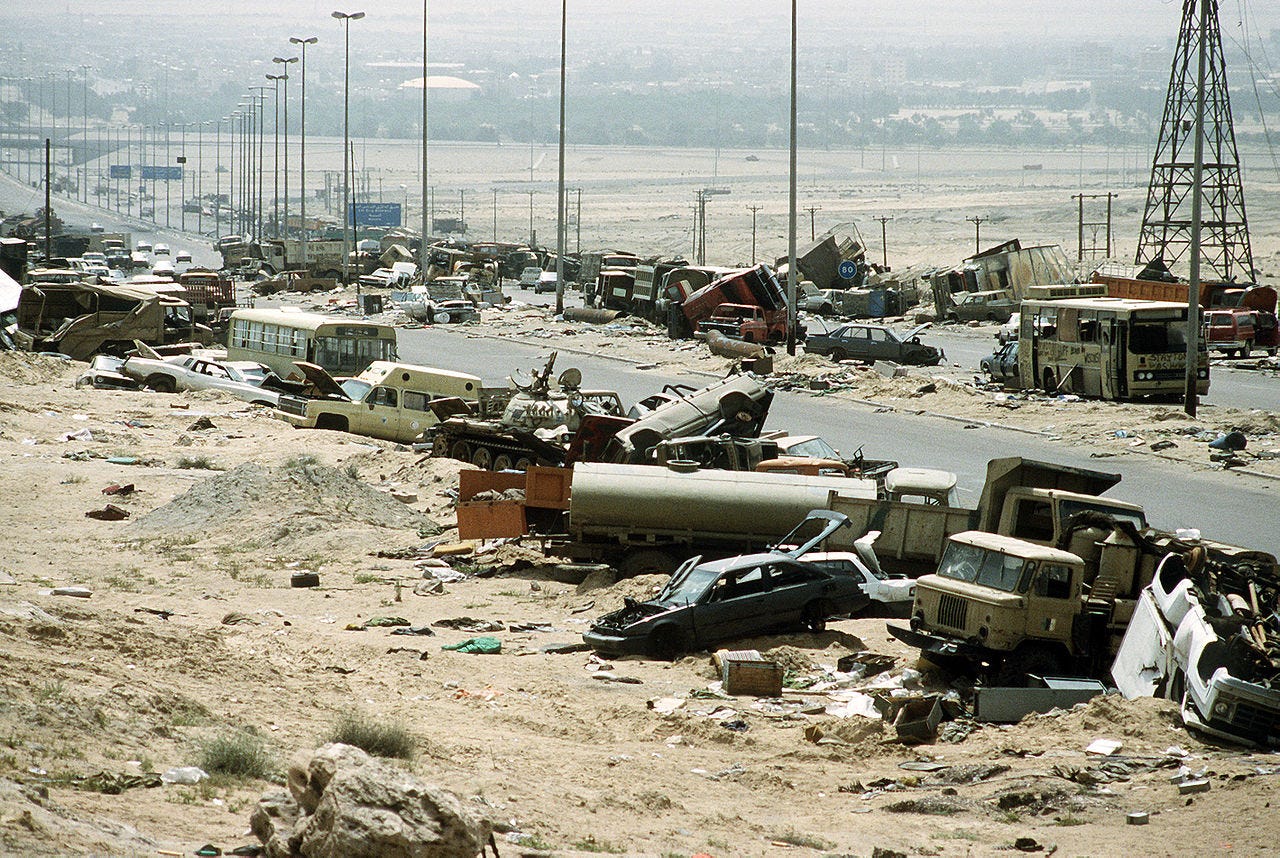
This distinction is made clear in the concept of surrender: if combatants wish to cease to be combatants, to cease to be subject to the violences of war, they may surrender. In practice, this is of course, no simple thing, but it is conceptually quite clear. Killing surrendering personnel is not part of war, being a political act (on whatever level it is initiated). If we return to Clausewitz’s definition of war, we may see why: war is an act of force to compel our enemy to do our will. When someone surrenders, they are no longer contesting our will and so no longer participating in war; their treatment becomes a matter of policy, not part of war.
It may seem futile to draw a line between war and politics, since by definition war is a continuation of politics. Yet, there are many parts of policy that do not belong to war and to which observations derived from the nature of war will be inapplicable. The distinction between war and “not-war” matters because war has a particular nature. This particular nature shapes its character, which cannot be counter to its nature. The concepts that Clausewitz identifies, the tendency towards the extreme, the superior power of the defensive, etc. provide a means of understanding war specifically. A theory of war claims no applicability to other phenomena, though elements may naturally overlap. The treatment of prisoners is not part of war, but it is one of many questions of policy that accompany it. For a theory of war to be of any use, there must be a clear answer as to when it is and is not suitable.
The Utility of a Theory of War
By looking at the nature of war and keeping in mind a clear definition (an act of force to compel our enemy to fulfill our will) we can see clearly what is not war. Violence against the non-resisting, while a political act of force, does not involve any opponent, and so is not war. There is no interaction and therefore is not subject to a theory of war. The “mass” upon which the force acts is not “dead” or inanimate, but it is, so far as violence is concerned, inert. It does not act, but is merely acted upon. As we have discussed, this is no pedantic distinction.
The strikes in the Caribbean are a vivid illustration of the value of disambiguating war from other uses of violence. Violence as a pure act of policy, distinct from war by the lack of battle, lack of contesting wills, possesses a different nature. To describe it as war is erroneous, and in this case, as in many others, it is also dishonest. The idea of war has utility as a political device, and so is invoked rhetorically. Even to the layman, the peculiarity of war’s nature is intuitively apparent. Without digressing into political theory, we may note the number of incentives for falsely claiming a state of war and asserting the naturally accompanying state of emergency. Knowing what constitutes war is a means to guard against both analytical confusion and those who seek to sow that confusion.
Well said. These attacks could be better described as terrorism than acts of war.
'Criminal acts, including against civilians, committed with intent to cause death or serious bodily injury, or taking of hostages, with the purpose to provoke a state of terror in the general public or in a group of persons or particular persons, intimidate a population or compel a government or an international organization to do or to abstain from doing any act, which constitute offences within the scope of and as defined in the international conventions and protocols relating to terrorism, are under no circumstances justifiable by considerations of a political, philosophical, ideological, racial, ethnic, religious or other similar nature, and calls upon all States to prevent such acts and, if not prevented, to ensure that such acts are punished by penalties consistent with their grave nature.' - United Nations Security Council Resolution 1566