


Introduction
If you read a summary of the life and career of Carl von Clausewitz, the impression you will get is that he served in the Napoleonic Wars as a staff officer, joined the Russians rather than serve under Napoleon, and—come peace—worked a desk job that gave him the time to write his magnum opus, left unfinished by his early death from cholera. While true statements, taken together they paint only a muddy picture of the arc of his life and provide one little help in understanding the man and his thought.
Central to understanding Clausewitz is that his political isolation and the stagnation of his career were not merely a product of royal disfavor over his actions in 1812, but a consequence of his views (shared by his friend Field Marshal August von Gneisenau) that Prussia needed to modernize. Specifically, Prussia needed to liberalize and rationalize by encouraging middle-class political participation, removing barriers to trade, establishing the rule of law, and granting a constitution. It was these views that were responsible for he and Gneisenau being treated as potential “Jacobins,” something that became a subject of embarrassment for later generations of Germans. With unification, the figures of the Wars of Liberation were heroicized, and so national mythology papered over the sharp divides of the Restoration. This is significant not only for the history of Germany’s political development, but accepting this framing obscures the real discontinuity between Clausewitz and later generations of Prussian officers. This discontinuity is nowhere better exemplified than in his conviction that it was necessary to be—and demand—far more intellectually than was expected of the traditional officer.
In this respect, Clausewitz certainly succeeded. Examining Clausewitz’s personal life reveals him as part of a humanistic, intellectual tradition, discussing war and politics in the informal, mixed-sex environment of salons, where aesthetics and poetry were no less frequent or serious topics. This social milieu forms a marked contrast with the near-monastic technocratic professionalism that would come to characterize the German General Staff, particularly during the Schlieffen years.1 Understanding Clausewitz’s life not only enables a greater understanding of his work, but is valuable in providing an understanding of the kind of environment that produced the only enduring theory of war.
In Donald Stoker’s recent biography, he writes, “Clausewitz was a Prussian officer to his core,” citing Clausewitz’s self-description in these terms in his “Observations on Prussia in her Great Catastrophe.” This was true in certain respects, but Clausewitz was far from the stereotypical Prussian officer, and taking this statement at face value elides Clausewitz’s conscious distance from his contemporaries. Indeed, the piece which Clausewitz felt the need to preface with this profession was so inflammatory in its criticism of Prussia’s policies and leading personalities in the 1806 campaign that it was not published until 1888, more than half a century after Clausewitz’s death. Clausewitz and his works should therefore not be understood as in direct continuity with the later Prusso-German tradition, but as an expression of views that, despite considerable overlap, were contrary to prevailing sentiments. Clausewitz saw his contemporaries as relying on a haphazard mix of truisms, maxims, anecdotes, and principles, producing assertions that could not bear the scrutiny of logic and history, which any valid theory required. On War was written because of what he saw as the failure of these military thinkers to look at war systematically, producing either illogical and inconsistent propositions, or else neat systems that could not withstand historical analysis. Thus, the ideas in On War are not completely original, but as a whole represent a dissent against the existing approach to thinking and teaching about military affairs.
This lone voice was powerful enough to make an impact, but it could not overturn the forces that had hitherto prevented war from being studied in a systematic and holistic manner. Clausewitz did not have a personality suited for propagating his views, and the political situation and his own position meant he had no institutional means of doing so. The result was a lack of continuity, so that later readers of his works interpreted them in light of the theories Clausewitz had rejected, failing to make real use of his contributions to military theory.
This all might well be taken as nothing more than a matter of historical curiosity were it not for the fact that Clausewitz continues to be victim of misinterpretation today—often in precisely the same way as he was by later German officers. For all that Clausewitz is taught and vaunted in the military academies of the United States, American officers have shown remarkable reticence to reckon with political factors, as Clausewitz insists is essential, and as history has demonstrated.2 Clausewitz’s work remains not only valid, but especially relevant precisely because its assertions remain contentious, no matter how common-sense they may appear. A right understanding of how to think and learn about war is a matter not only of success or failure, but of life or death for many.
Twilight of Frederician Prussia
The Formation of a Reformer
Carl von Clausewitz was born on July 1, 1780, as the youngest of four brothers, in the town of Burg bei Magdeburg, in what is now Saxony-Anhalt. In the year of his birth, Prussian Enlightened Absolutism was at its height, with the devastation of the Seven Years’ War in the past and the country remaining neutral in the Anglo-French War that had emerged from the ongoing American Revolution. Despite his birth being recorded in the local church’s records as in July, it is evident that Carl believed he was born on June 1, as later letters show his birthday being celebrated on this date.3 The likely root of his misconception lies in the fact that the Prussian army at this time greatly valued seniority, and by claiming Carl had been born a month earlier than he had, Carl’s father was able to enter him into the Prussian army a year earlier than he otherwise could have been. He therefore had the fortune to be enlisted at the age of twelve as a flag carrier, which was common practice in Prussia’s nobility. In fact, he only handed the colors when the regiment passed through towns, and he recalled residents gawking at the small boy struggling to bear their weight.45 Clausewitz would write twenty-nine years later that the experience of being parted from his family at such a young age affected him deeply. “I still have the most distinct impression of the melancholy feeling that, especially then, beleaguered my heart and which really never wholly left me.”6
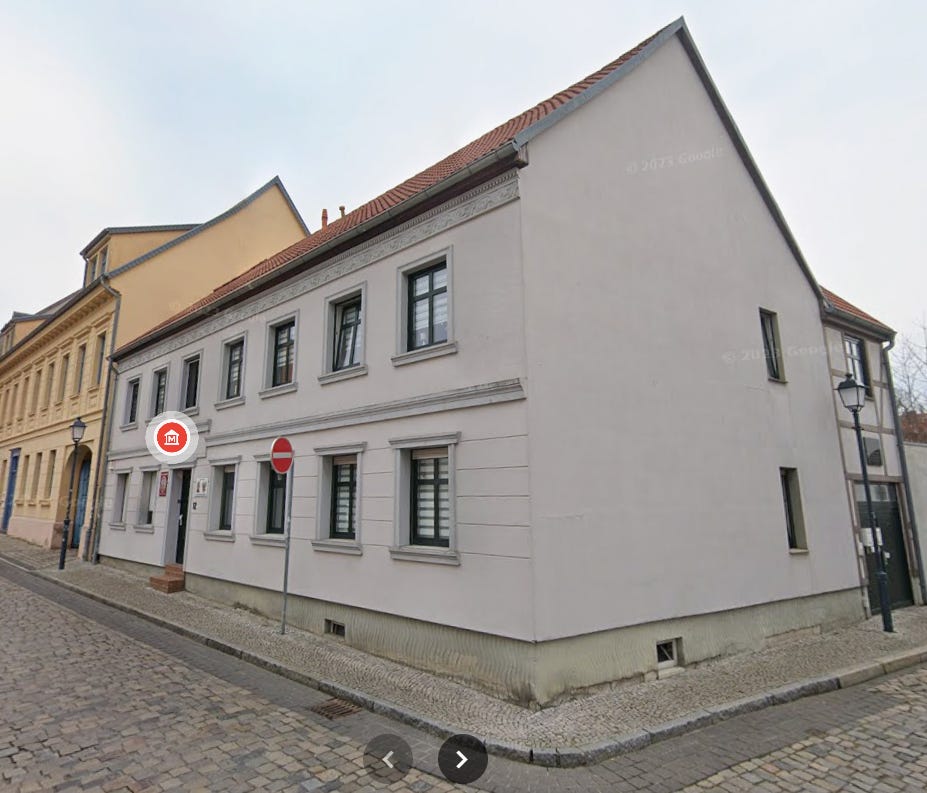
Clausewitz’s oldest brother had entered a career as a civil servant, as the family’s dubious claim to nobility precluded a career as an officer so long as Frederick the Great reigned (Clausewitz’s father had been able to serve while the exigencies of war loosened the requirements). Following the old king’s death, restrictions were loosened, and the remarriage of Carl’s grandmother to nobleman Gustav Detlaf von Hundt permitted the younger brothers to enter the army as officers, despite their lack of pedigree. Carl and the second-youngest of his brothers were able to join the prestigious 34th Infantry Regiment, of which Hundt was the commanding officer and of which the late king’s youngest brother, Prince Ferdinand, was its commandant en chef.7 This nevertheless left the Clausewitz brothers as outsiders, surrounded by the sons of blue-blooded Junkers, and Carl would recall that they maintained their place only through a readiness to duel if challenged on their claims.8
Carl’s career as a child soldier was not a peaceful one. Not long after the French Revolution occurred, the War of the First Coalition began, ranging the newly reconciled Prussia and Austria against the armies of Revolutionary France. The war was a half-hearted affair, hindered by the irresolution of the coalition and the disorganization of France’s armies. The coalition won victories, but was unwilling to accept the risks involved in exploiting them. It was also neither particularly unified nor committed to crushing the Revolution, taking a greater interest in the partition of Poland. Clausewitz had joined his unit not long after the war broke out. Clausewitz would later recount, “in my twelfth year I made my first foray into the trenches before Mainz; as Mainz fell prey to the flames, which we had fanned, the jubilation of the rough soldiery also carried up my childish voice.”9 The Siege of Mainz was more famously witnessed by the poet Goethe, and Clausewitz likely deliberately contrasted his naive indifference to Goethe’s horror at the human cost of war in this account of his own intellectual development.10
Marching through the Vosges was hardly the healthiest occupation for a child—and Clausewitz was a frail one. Yet, against the expectations of his comrades, of the unit’s three ensigns Carl would be the only one to survive the strains of the campaign.11 Disease and exhaustion were not the only dangers he faced as an adolescent; he wrote that “on my fourteenth [birthday], I found myself in a bad situation during an intense action, from which I luckily emerged.”12 Carl’s luck held until mid-1794, when Prussia began seeking to exit the war. Though peace was not officially signed until a year later, Clausewitz’s regiment saw no further action. The prospect of the stagnant drudgery of garrison life, however, made peace seem a more fearsome prospect than war. In the absence of an opportunity to advance himself by distinction in war, the fifteen-year-old sought to find another way of satisfying his innate ambition: through education.
Clausewitz later described his upbringing as “very mediocre”,13 a view tinged by not-unjustified bitterness at his lack of formal education. Yet, for all the limitations of provincial life in peacetime, he was in fact fortunate to be in an environment supportive of learning, with a commanding officer personally interested in new ideas.14 Clausewitz was therefore able to dip into the intellectual currents produced by the French Revolution from a young age, despite his lack of a formal education. He would later recall a formative experience after the campaign of 1794, when he was quartered for three or four months with a farming family, as the unit awaited the signing of a formal peace: “We were near Osnabrück; one could get books there; I began to read, and by chance some Illuminati writings and other books on the perfectibility of Man fell into my hands. At a single stroke, the vanity of the little soldier became extreme philosophical ambition, and I was then as close to rapture as was permitted for a spirit without any strong tendency towards it.” With typical self-criticism he continues, “Had these embers within me been better nurtured and used, I would perhaps have turned out a good deal better than I am.”15
These recollections are contained in letters to his future wife, who was far better bred and far better educated, and the description of his upbringing has to be seen in light of his self-consciousness of his relative inferiority and penchant for self-deprecation. It is therefore necessary not to take Clausewitz strictly at his word—or, at least—not to take his word literally.16 For example, he describes himself in Neuruppin, where the regiment was subsequently garrisoned, as “hemmed in and surrounded by nothing but prosaic phenomena and natures, with nothing to distinguish my existence from the best of my comrades (that is to say, ordinary people) aside from the inclination towards thinking, literature, and military ambition—this was the only vestige of the earlier fervor.”17 From this description, one would never guess that Neuruppin was where Frederick the Great had resided as crown prince and had a library of 2,000 volumes. Nor would one have guessed that the 34th Infantry Regiment’s commander since 1793, Friedrich Wilhelm Alexander von Tschammer und Osten, ran a school for the lance corporals and ensigns of the regiment. Tschammer had taken this up since many of them, like Clausewitz, had entered the army with very little formal education, and Tschammer believed a grounded, general education could better a person, and so was valuable even to the soldier.18 It’s unclear precisely what Clausewitz’s involvement with this school was as a lieutenant, but Tschammer’s brief yearly reports to the king on Clausewitz refer to his intelligence and interest in acquiring knowledge. Indeed, the school garnered enough attention that civilians began to attend as well. Gneisenau, then a mere battalion commander, praised the regiment as a model for military education.
Yet, it is also easy to understand why Clausewitz did not portray his educational development particularly positively, even if it was objectively far superior to that of many of his contemporaries: concerns surrounding social stability meant education outside the very elite was primarily practical, refraining from approaching those topics that Clausewitz’s brief encounter with Enlightenment literature had instilled a yearning for. However, as Peter Paret notes, Tschammer’s educational philosophy left a lasting mark on Clausewitz’s thinking, particularly via “Tschammer’s praise of education as the means of advancing the individual and society, his plea that the soldier should not stand apart from the general progress of civilization, and especially his belief that the primary function of education was not the acquisition of knowledge but the development of judgment, without which the soldier was only an animal.”19 These early questions of the soldier’s place in a changing society and how he could be educated for this role proved central to Clausewitz’s work, and stimulated his investigation into the question of the nature of war itself. But while Clausewitz’s self-consciousness belies the advantages of his upbringing, it is true that his limited formal education had narrowed his intellectual horizons. As he understood, to pursue the ambitions that still smoldered within him, he needed a change of circumstance.
To accomplish this, he resolved to take what was the only path open to him: attending the Berlin Institute for Young Officers, beginning in 1801. As he would recount in later years, he breezed through the entrance exam, but struggled greatly once in attendance, surrounded by blue-blooded schoolmates who put to shame Carl’s haphazard education.20 His inability to follow much of the content of the classes drove Carl to despair, even to the verge of leaving the army. Yet, it was in this nadir that perhaps the greatest fortune of Clausewitz’s life would find him: head of the institute, Gerhard von Scharnhorst (1755-1813), took him under his wing. Perhaps Scharnhorst recognized a fellow talented outsider; his own background lacked even the pretense to nobility that the Clausewitzes maintained.
Carl would become not only his student and protégé, but later his assistant in organizing Prussia’s military revival. The two men would lean heavily on one another—Carl described Scharnhorst as “the father and friend of my spirit.”21 Later on, August von Gneisenau would write to Clausewitz, “You were Scharnhorst’s John, I only his Peter—though I was never untrue to him, as the other was to his master.”22 In Scharnhorst’s 1803 report on his students, he divided them into four classes based upon performance, with Clausewitz and Karl von Tiedemann the two students ranked in the first class.23 Clausewitz would go on to work closely with this fellow disciple of Scharnhorst’s, and he became acquainted with many other prominent officers and members of court through both his lectures and Scharnhorst’s Militärische Gesellschaft (literally “military society”), which discussed military science in meetings and in print, seeking to establish how Prussia could keep pace with France’s growing military predominance and advocate for the necessary reforms.
For the moment, then, things seemed to be looking up for the young Clausewitz,24 who had excelled in his studies and gained the friendship of a man well-placed to further the development of both his mind and career. The courses at the academy included lectures by Johann Gottfried Kiesewetter, an evangelizer of Kant’s with a talent for communicating the philosopher’s ideas in a clear and engaging manner—ideas that would influence Clausewitz’s own philosophical approach and his insistence on the consistency of theory with empirical phenomena.25 In 1804, he graduated at the top of his class, earning himself the position of adjutant to the twenty-four-year-old Prince August, great-nephew of Frederick the Great, and cousin of the new king (Friedrich Wilhelm III r. 1797-1840), and youngest son of Prince Ferdinand, whose regiment Carl had belonged to. In recommending him, Scharnhorst had praised Clausewitz’s work for its “rare correct judgment of the whole” and a “modest and pleasant presentation.”26
While Clausewitz would have preferred to command a unit in the line, his position was nevertheless well suited to his ambitions: as adjutant to Prince August, he was regularly attending events that brought him into courtly life at its highest levels. Not only did this allow him to take part in the vivid discussions of culture and politics that occurred in the salons of Berlin, but it acquainted him with figures of both political and intellectual significance. While Clausewitz’s youth and early education had familiarized him with the ideas of the Enlightenment, these gatherings immersed him in the burgeoning Romantic movement. The Romantics emphasized the intangible aspects of Man’s inner life, rejecting the Enlightenment’s search for certainty through objective observation and reason. It is clear that he was deeply invested in these questions and debates; in just his early writings, Clausewitz referred to Machiavelli, Montaigne, Montesquieu, Robertson, Johannes von Müller, Ancillon, and Gentz.27
As he mentioned in his letter describing his moment of near-rapture, Clausewitz was not given to being swept away by emotion and grand ideas, but Scharnhorst’s influence also imbued him with a healthy skepticism of Romanticism. Scharnhorst’s relentless pragmatism—alongside his insistence that the diversity of history meant it was impossible to establish universally valid rules—gave Clausewitz the intellectual structure to eschew the contempt for a “barbaric” past that characterized the Enlightenment without succumbing to the Romantics’ fascination with a “noble” past. Instead, these currents collided within him to produce an outlook that both sought rational understanding and appreciated the power of that which could not be comprehended through reason alone.
The Great Romance and the Long Courtship
In Berlin, Clausewitz not only found Romanticism but romance. It was there he caught the eye of Marie, the daughter of the formidable Countess Sophie von Brühl. The Brühl family was a prominent one; Marie’s grandfather, Heinrich von Brühl (1700-1763), had been minister to Augustus the Strong, Elector of Saxony and King of Poland, and had been Prime Minister to his successor, Augustus III. Today the Brühlterrasse in Dresden bears their name, as did a Brühl palace in Warsaw until 1944, when it was deliberately destroyed by the Nazis (its reconstruction is planned). With Saxony’s defeat in the Seven Years’ War, the family lost influence and suffered from Frederick the Great vengefully plundering their estates.28 Marie’s father, Carl Adolf von Brühl, at first sought to continue serving in Poland, but following the First Partition of Poland the weakness of its government led him to seek Russian service. It was here he met Sophie Gomm, born to a British merchant family, and the two quickly fell in love. Despite her being only sixteen and his being twenty years the elder, the two apparently enjoyed a happy marriage.29 With the failure to attain a position in Russia and the continued decline of Poland, the Brühls returned to Saxony and, en route, Sophie gave birth in Warsaw to the couple’s first child on June 3, 1779, named Maria Sophia, or Marie.30
In Marie’s memories of her earliest years spent in Pegau (near Dresden), she recalls the births of her siblings; of these, only her sister Caroline Franziska “Fanny” and her brother Friedrich “Fritz” would survive to adulthood. She also recalls that “My father taught me to write himself,” giving some indication of not only the closeness of the family but the value placed on education.31 Marie spent time with the Brühl extended family, her father’s brothers and their children, including her cousin Carl von Brühl (1772-1837), who knew Goethe and in 1815 became director of the Royal Theater and later the Royal Museums (now Berlin’s Museum Island’s Alte Museum). His biographer noted that “Karl was as close to her as a brother,” a fact which may have contributed to her strong knowledge and interest in art and culture.32
In 1787, when Marie was seven years old, the life of the Brühls saw a dramatic change, so much so that she described it as “like the entry to a new world.”33 Frederick the Great had died the previous year, and his successor, Friedrich Wilhelm II, was a strongly contrasting personality who would ultimately earn a poor historical reputation as a ruler preoccupied with the pleasures of life rather than the needs of the state. Yet, the new king’s intent to make a break with the policies of his predecessor allowed Marie’s father—much to his surprise—to be appointed to the position of governor to the crown prince (Friedrich Wilhelm III).34 This was the same discontinuity that had allowed Carl and his older brothers to become officers, giving some idea of the disparity in social position. Even more telling is that while Carl considered himself lucky for emerging from the “intense action” with his life on his fourteenth birthday, Marie recalls spending hers on the ancestral estate of Pförten. Likewise, while Carl was literally in the trenches, she remembered that “In Karlsbad, the conquest of Mainz was celebrated with a grand ball.”35
Despite their overall flagging fortunes, the Brühls proved successful courtiers. Marie recalls that they lived a floor above the apartments of the crown prince and his brother, and the family became integrated into royal life, even if they did not become particularly close to the young prince. When the prince came of age, Marie’s father continued his service as his chamberlain, and her mother Sophie became a fixture of court life.36 Friedrich Wilhelm II died in November of 1797 and Marie was first presented to the court in 1798, soon becoming a lady-in-waiting to the Dowager Queen Friederike Luise. Marie quickly proved adept at navigating the social world of courtly life, also becoming close with Luise von Voss (born Luise von Berg), daughter of Karoline Friederike von Berg, who was lady-in-waiting to the young Queen Louise. Berg had spent time in Weimar and had become acquainted with writers like Goethe, Schiller, and Herder, and so constituted a literary and intellectual circle around Prussia’s queen, one that Marie took part in.37
With the family’s weak financial position, Sophie sought to make Marie and her younger sister, or “Fanny,” into what Friedrich August von der Marwitz (who would marry Fanny in 1803) called “truly something exceptional and genuine phenomena.” To this end, the girls were educated in a variety of subjects, including the arts and history, in the latter of which Marwitz noted both sisters excelled.38 Due to their mother’s heritage, the sisters were brought up in Berlin’s small circle of English speakers, and so also became acquainted with the American envoy John Quincy Adams and his wife Louisa.39 Marie recalled many English visitors in 1798 and 1799, particularly Prince Augustus Frederick of Sussex, son of George III.40
The contrast with Clausewitz’s pedigree and background could hardly have been more complete. These had left him woefully unqualified for this social environment, a fact he was all too aware of and sought to remedy through study of etiquette, attested to by his personal library.41 His efforts at refinement were successful, though his self-consciousness and inherent sensitivity meant he could come across as melancholic and even arrogant, only opening up to those whom he felt comfortable around. He did not lack friends, but never (for lack of ability or inclination) mastered the skill of the courtier to maintain friendly relations with those he felt were unworthy of them.
In the winter of 1801, Marie was somewhat sickly, and so accompanied her friend Luise to the countryside retreat of Giewitz. Though for the sake of her health, for Marie the significance was to her intellectual development. “I became familiar with all the best of German writers and found in them everything that I until then had sought in vain, and strength for the sad time that came upon me.”42 The “sad time” that followed was on account of the death of her beloved father, whom she found had died while she was away. In her recollection of past New Year’s celebrations, Marie wrote “On the last days of the also-sad year of 1802, my heart was so heavy that I could not bear to be in my mother’s room. I went into my own without light and lay on the sofa to surrender myself to my thoughts and feelings. For me, it was as though I had been abandoned by the whole world, as though my life was now wholly concluded and all joy, all happiness was forever over for me, and yet I had the true highest happiness still to discover.”43
“This highest happiness” did not come about easily. It was circumstances rather than disposition that made their first meeting awkward; it occurred at a supper hosted by Prince Ferdinand, her first outing since the death of her father. They first spoke moments after the mention of Marie’s father forced her to step away and compose herself, and she remained too affected to do more than exchange pleasantries. As she puts it, their meeting meant “this melancholy day bound itself with the beginning of my highest happiness.”44 Their second encounter still saw Marie withdrawn, but Carl conversed with her cousin, Carl von Brühl, who praised him to Marie as “an excellent young man.” Marie found she regretted her earlier “indifference” and sought him out at their next meeting.
She recalls that “my friends, especially Charlotte [von Moltke], teased me about the impression I had made on him, long before I had the courage to admit it to myself.”45 Her disbelief stemmed from a fairly depressing cause: “With my lowly opinion of myself and all the reasons I had for it, it took some time for me to be persuaded that anyone could feel so deeply for me.”46 This rather sad sentiment on Marie’s part can be explained by the fact that despite her mother’s efforts to match her with Marwitz, he had instead preferred her younger sister—at least partially because she was the prettier of the two. Certainly, this element was what most affected Marie, but Marwitz also mentions that he saw Marie as too eager to please her mother by her industriousness, and preferred the frail, shy, innocent, but (in a certain sense) more individual Fanny.47
It is worth noting that Marwitz was a dyed-in-the-wool Junker, an aristocrat from one of Prussia’s oldest families—one who would prove an obstinate opponent to the abolition of serfdom or anything that reduced the privileges of the nobility. Thus, his dismissal of Marie in part due to her similarity with her outspoken and intimidating mother may also be attributed to a desire for a bride who met a more conservative vision of femininity; the “individuality” Marwitz valued in Fanny was (in that sense) in fact conformity, and indeed to a much stricter line than that of even the exacting Sophie von Brühl.
Whether we ascribe Marwitz’s decision to superficial concerns or traditionalist ones, the experience of being passed over fostered a sense of insecurity in Marie, the consequence of which was that even though she knew her feelings towards Carl early, she did not yet allow herself to believe them, fearing them too good to be true. “I therefore took this feeling very lightly, as something that could soon be over again, and that I should therefore permit no particular influence over me; nevertheless, he delighted me and excited my full attention.”48 Marie’s hesitance also kept Carl in uncertainty about her feelings, especially in light of his awareness of his social and financial unsuitability to be a serious suitor.
Thus, despite the early recognition of mutual affection, the road for the couple would not be straight. In love, as in war, even the simplest thing may be difficult. Opportunities for clarification were scarce, as both were kept busy with their duties at court and so only saw one another occasionally, searching for brief opportunities at official functions. Yet, Marie would later say that the anticipation and secrecy of it all only intensified their feelings.
Tragedy again interfered, this time with the death of Marie’s younger sister, Fanny, not long after childbirth. Her husband, Marwitz, was grief-stricken and, in his own account, lacked any idea of how to care for an infant and so left his daughter in Berlin with her grandmother while he returned to his country estate of Friedersdorf. Fanny’s daughter was named Franziska Caroline, after her mother, and she spent her early years with Sophie and Marie before Marwitz ultimately reclaimed her.
This personal drama had meant many months apart for Carl and Marie. The result of this, as she later recalled, was that “when he stood in front of me so unexpectedly, my surprise and emotion were so great that my voice failed me for a moment, and I greatly feared the observant glances of my colleagues. This day is memorable to me because it was the first that made me really pay attention to what was occurring in my heart and see it as much more significant than I had until then believed.”49 They were again hindered by death (though this time a far less untimely one): that of the Dowager Queen Friederike, for whom Marie had been a lady-in-waiting. This sudden end to her duties reduced Marie’s appearances at court and left her anxious for an opportunity to see Carl again. When she finally did encounter him, despite her inner excitement (or perhaps because of it), she came across as “cold and unfriendly.” Yet, in hindsight she recognized that her infatuation was already so great that she clearly recalled the first time their hands touched accidentally. That very same evening Carl helped her put on her shawl for the first time, and they began to see one another more regularly in public.
The world events of 1805 were beginning to impact the relationship; Marie’s feelings were intensified as mobilization began to be discussed. As Marie spoke more of Carl, her friend Charlotte von Moltke wondered to her why he had not yet declared his intentions. Marie attributed this partly to Carl’s natural reserve, but also believed she was responsible in that she occasionally treated him coldly or dismissively, which she attributed to “embarrassment and perhaps a few times the really childish, unreasonable fear of losing my inner freedom,” and reproached herself for doing so. As the prospect of war drew closer, she greatly feared leaving him in a state of anxiety about her feelings. In fact, “This fear would have made me soon forget all conventional considerations and be entirely open to him if chance had given us the opportunity for a clarification… but that opportunity was never available, and how could I speak so long as he remained silent?”50 Marie continued to attend the comedies in hopes of encountering him and finally managed to meet him briefly and in the company of others. This gave her only the opportunity to say a brief farewell should they not meet before mobilization was announced. Her disquiet thus continued, and she accompanied her niece and her governess on an errand in hopes of encountering Carl, since Prince August’s battalion was on parade nearby. She looked for him in vain, finally joining the governess and her niece in the shop in despair, when Carl happened to walk in the door. The coming and going of customers gave them a modicum of privacy. He expressed to her the high hopes with which he marched out and the joy it would give him to return with good tidings. Marie recalls,
“I said that I hoped that he would not forget his friends here; then, while he took my hand and kissed it, he said, deeply moved and with great meaning, ‘Oh, who has seen you once, will never again forget you!’ His look, the tone of his voice with these words moved me to the depths of my soul and will ever be unforgettable to me… this moment is amongst the most beautiful and most important of our lives; since we had understood one another, and the bond of our souls was silently sealed… Just a day before it seemed a crushing weight lay upon my soul; as soon as I was alone for a moment, I sank into deep, gloomy thoughts. As if by the force of magic, a single moment had transformed these hurts into bliss.”51
Carl evidently was no less affected, for Marie remembers how “On the way home, Carl rode some distance from us; he looked around often and in his distraction rode through the low gate of the palace that was only for pedestrians; I have since then never seen one without thinking of that day.”52 Marie did not see him again until the day of mobilization, when they shared a glance as the soldiers marched from Berlin. “We believed that this mobilization would lead to a long absence and to great events, but fate decided otherwise.”53
“Fate” in this case was Napoleon’s victory in the Battle of Austerlitz, smashing both the Austrian and Russian armies, defeating the coalition that Prussia stood on the cusp of joining. Prussia’s ambassador, Count Haugwitz, had been sent to deliver the French an ultimatum but was allowed to see Napoleon only after the battle had been decided. Instead, in a course Clausewitz would later severely condemn in his analysis of this campaign, he negotiated an alliance with the French, despite having been sent by his government to initiate hostilities. Upon Clausewitz’s early return, although Marie was happy to see him, “the memory of our parting made me very abashed, and I became more so through the presence of so many people whose looks and notice I feared, so that C[arl] found me cold.”
Yet, though she looks back on it with shame, there was another reason she seemed cold: “I am certainly not cold; that is an accusation I don’t need to fear from those who truly know me, but calm and prudence have belonged to the fundamental features of my nature since my earliest childhood.” As she explains, no matter how deeply she felt, it would have been contrary to her nature to allow herself to be carried away by feelings without reflection. Notably, this view of a person’s defined nature is present in Carl’s military writings, for instance in his comparison of Napoleon and Frederick the Great, where (contradicting Jomini) he asserted their fundamental differences in their arts of war, justified by differences in their own positions, characters, and characters of their enemies.
For Marie, the moment of mobilization had briefly overcome her nature, but it reasserted itself when the crisis fizzled out. “Now, however, everything too quickly returned to ordinary, prosaic existence not to wake me from my sweet poetic dream, and bring me to a more serious examination of my situation. I had arrived at the point where my relationship with C[arl] either would become indissoluble, or must return to a mere friendship.”54 Marie was no young girl, liable to be swept away by her feelings. Indeed, she writes that “even if C[arl] had appeared to be equipped with all the earthly goods that would win our union the acclaim of the world and could secure the consent of my mother, and he had publicly offered me his hand, this moment would nevertheless be a very serious one for me.” Carl, of course, had none of those things in his favor at that time. The Brühl family had fallen on hard times, but Marie’s mother Sophie was an imperial countess, a direct vassal of the Holy Roman Emperor; Marie’s father had been the governor and chamberlain of Friedrich Wilhelm III. This was some distance from the Clausewitzes, a family of lesser officers, priests, and bureaucrats, with an essentially fictitious claim to nobility.
Marie had deduced much of this: “C[arl]’s circumstances were totally unknown to me; I didn’t know whether he could ever consider a serious relationship; his previous silence meant I had rather to assume the contrary, and in any case the fiercest resistance on the part of my mother was not in doubt, and to enter into and continue in such a relationship in secret and without her consent was so contrary to my open nature that the degree of love I felt for C[arl] was what later moved me to it.” Even though Marie had known him for three years, “how little could I judge whether our characters would fit one another well in such an intimate relationship.”55
As Marie tells it, these prudent reservations would have vanished before the strength of her feelings, but there was no occasion for her to realize this. Caution was not the only thing to blame for her sudden coldness: “perhaps it was also the embarrassment from having shown my feelings too clearly at our parting that had again goaded my irrational pride into reasserting my inner freedom, which was, in fact, already irrevocably lost.”56
Marie’s concerns about losing her inner freedom were less, as one might assume, to do with the loss of independence that came with marriage than with the intrinsic dependence that came with love and matrimony in the intellectual and spiritual sense. As Carl’s rapturous youthful experience reading Illuminati literature exemplified, ideas of personal development and education were common currency in the intellectual elite to which Marie belonged. She took them seriously, and so had to consider what love and marriage would mean for her interior life. While Marie in retrospect dismissively described her desire to preserve her freedom as “prideful” or “really childish,” Carl expressed contrary sentiments when reflecting on their early courtship, describing her freedom as “priceless,” deeply appreciating what her trust in him meant. When writing in retrospect, Marie believed the outcome was never in doubt: “In short, all these good and bad reasons could not bring me to the conclusion to distance myself from C[arl]; that I couldn’t have done, even if I had wanted to; but they brought me to the conviction that I must again be more reserved towards him… but this artificial indifference could not last and had to give way to an even deeper emotion.”57
Nevertheless, Marie did not regret the tribulations that their relationship had to endure, believing that the obstacles they encountered gave them the opportunity to prove and deepen the strength of their bond. Curiously, she writes that “with my external quietude, that was so often in contrast with C[arl]’s vivaciousness, it would have certainly been harder to convince him of the full strength and intensity of my love if I had not had to struggle and endure so much for him.” Carl had a reputation for reservedness to the point that others at times mistook his cold bearing for condescension. Marie’s cousin Carl recommended him to his father (Marie’s uncle) with the description: “At first he’s somewhat withdrawn, but the more one comes to know him, the more one likes him…”58 He was known to be lively with close friends, but the extent of that transformation is illustrated by the fact that Marie felt so outdone by him in terms of visible emotion that she apparently felt unable to express her feelings adequately except by demonstration.
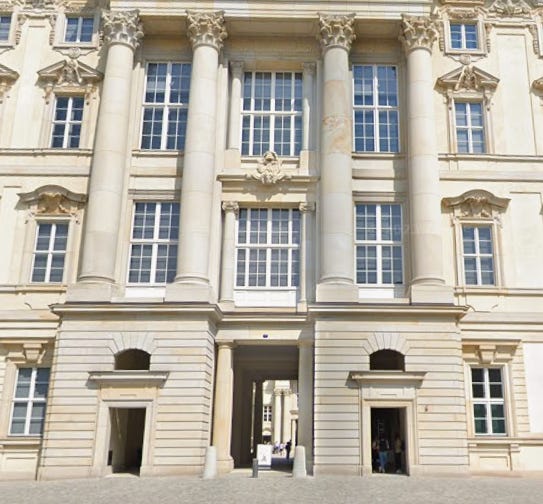
Pedestrian gates, one of which Carl rode through while distracted, part of the reconstructed Berlin City Palace.
In a later letter to Carl, Marie emotionally conveyed her sense that they were destined to meet, describing her feelings towards prior suitors: “It was not a lack of feeling that closed my heart, but rather the men I came to know. With the most of them, any closer connection would have been a horror to me, and even with the better ones I found a lack of the purity and sanctity of sentiment, the depth of emotion that is absolutely a necessity for me, and without which I could not imagine a truly happy marriage; or, where I did find a more sensitive disposition, it degenerated into weak flaccidity and effeminate touchiness.” She contrasts this with Carl who “unites all qualities” to achieve her ideal of “masculine perfection.”59
Ultimately, when Carl asked frankly whether she loved him, she waited a couple of days before finally meeting with him and committing to the relationship, despite all the practical arguments to the contrary. Unusually for the time, the relationship would be a true partnership. This was a matter of practicality as well as principle; it would only be possible for them to marry if Marie actively worked towards Carl’s rise, as she was by far the better positioned of the couple.
World events once again intruded: with Napoleon ascendant, he was now putting the screws to Prussia, which was paying the price for its policy of neutrality. Marie’s English mother, Sophie, finally left mourning and, as one lady at court wrote, “reinvigorated from all the hate against Napoleon…she and her daughter Marie lived only in the fervor of politics and the hatred against the French.” 60 Clausewitz, like most officers, favored war with the French, and as adjutant to Prince August was often at social events of like-minded individuals, often hosted by the prince’s father, Prince Ferdinand. This also brought Carl into contact with Ferdinand’s other children, Louis Ferdinand and particularly Louise Radziwiłł, who was herself a notable salonaire, and she and her Polish husband Antoni would remain lifelong friends of the Clausewitzes.
In July of 1806, Carl was mobilized again, and this time it was to be in earnest. In a letter not long after his departure, he informs Marie that the night before leaving he could not resist looking anxiously up at her window, hoping in vain to see some sign of her. “The next morning I could not help but ride past your house one more time, but there was no trace of your existence to be seen. Soon thereafter I saw your brother and while, on the one hand, I could not resist speaking a few words with him, but on the other hand, I had not the courage to ask him to bring a greeting to you, which hovered upon my lips and was such a need of my heart. When I saw you, I had already given up all hope. Oh truly, it was one of the most beautiful occurrences of my life!”61 Marie also gave him a ring to remember her by.62
For all the success on the romantic front, Carl went to war with little confidence in victory. The war party had gotten the confrontation with France it wanted, but its execution left much to be desired. Despite the efforts of Scharnhorst, very few reforms had been made to the army, and Prussian high command was both institutionally confused and not especially competent. Worse still, the coalition included only a handful of German states, with Russia being Prussia’s only major ally and too geographically distant to play an immediate part in the war.
Nevertheless, Carl believed they had some chance of success: “If I draw a conclusion from all the considerations I am obliged to employ, then there is still the probability that we will be the victors in the next great battle.”63 Naturally, Carl hoped to win some glory that would allow him and Marie to progress their relationship. Carl, as a self-identified “sensitive person,” understandably wanted to have more to offer his partner than his current status could provide. He was very much aware of (and uncomfortable with) the risks Marie was taking by entering into a relationship with him, someone much inferior in rank and practically penniless, writing, “Indeed, where I reaped the most beautiful fruit, you reaped only sacrifices.”64 He understood that only a major battle would give him the opportunity to distinguish himself and realize any of his ambitions, the dearest of which was, of course, marrying Marie.65 “My fatherland needs war, and—plainly speaking—war alone can lead me to a happy end.” In the long run, he was not wrong in his assessment. For the time being, however, fate intended to be less than cooperative.
Bibliography
Bellinger, Vanya Eftimova. Marie von Clausewitz: The Woman Behind the Making of On War. Oxford: Oxford University Press, 2015.
Brühl, Karl von. Writings and correspondence. In Karl Graf von Brühl, General-Intendant der Königlichen Schauspiele, später der Museen in Berlin, und seine Eltern: Lebensbilder auf Grund der Handschriften des Archivs zu Seifersdorf. Edited by Hans von Krosigk. Berlin: E. S. Mittler und Sohn, 1910.
Clausewitz, Carl von. Historical and Political Writings. Edited and translated by Peter Paret and Daniel Moran. Princeton, NJ: Princeton University Press, 1992.
Clausewitz, Carl von. For correspondence, see the editions by Karl Linnebach and Karl Schwartz.
Delbrück, Hans. Das Leben des Feldmarschalls Grafen Neithardt von Gneisenau. Vol. 5. Berlin: G. Reimer, 1880.
Geheimes Staatsarchiv Preußischer Kulturbesitz, Berlin. VI. HA, FA Buttlar-Venedien, v. (Dep.). Correspondence of Carl and Marie von Clausewitz.
Goethe, Johann Wolfgang von. Belagerung von Mainz. Project Gutenberg, e-book no. 17657, February 1, 2006.
Kirchenbuch, Burg bei Magdeburg. Birth record of Carl von Clausewitz, July 1, 1780. Digitized by the Clausewitz Society of Burg.
Krosigk, Hans von. Karl Graf von Brühl, General-Intendant der Königlichen Schauspiele, später der Museen in Berlin, und seine Eltern: Lebensbilder auf Grund der Handschriften des Archivs zu Seifersdorf. Berlin: E. S. Mittler und Sohn, 1910.
Lehmann, Max. Scharnhorst: Bis zum Tilsiter Frieden. Vol. 1. Leipzig: Hirzel, 1886.
Linnebach, Karl, ed. Karl u. Marie v. Clausewitz: Ein Lebensbild in Briefen und Tagebuchblättern. Berlin: M. Warneck, 1916.
Marwitz, Friedrich August Ludwig von der. Ein märkischer Edelmann im Zeitalter der Befreiungskriege. Edited by Friedrich Meusel. 3 vols. Berlin: E. S. Mittler und Sohn, 1908.
Paret, Peter. Clausewitz and the State: The Man, His Theories, and His Times. Princeton, NJ: Princeton University Press, 2007.
Rochow, Caroline von, and Marie de la Motte Fouqué. Vom Leben am preußischen Hofe 1815–1852. Edited by Luise von der Marwitz. Berlin: E. S. Mittler und Sohn, 1908. Cited through Bellinger.
Rosinski, Herbert. “Scharnhorst to Schlieffen: The Rise and Decline of German Military Thought.” Naval War College Review 29, no. 3 (Summer 1976): 83–103.
Rothfels, Hans. Carl von Clausewitz: Politik und Krieg: Eine ideengeschichtliche Studie. Bonn: Dümmler, 1980.
Schwartz, Karl. Leben des Generals Carl von Clausewitz und der Frau Marie von Clausewitz, geb. Gräfin von Brühl: Mit Briefen, Tagebüchern und anderen Schriftstücken. 2 vols. Berlin: Dümmler, 1878.
Stoker, Donald. Clausewitz: His Life and Work. Oxford: Oxford University Press, 2014.
See Herbert Rosinski, “Scharnhorst to Schlieffen: The Rise and Decline of German Military Thought,” Naval War College Review 29, no. 3 (Summer 1976): 83–103.
This is, of course, far from a uniquely American problem, but the American veneration of Clausewitz is particularly intense.
Karl Schwartz, Leben des Generals Carl von Clausewitz und der Frau Marie von Clausewitz, geb. Gräfin von Brühl: Mit Briefen, Tagebüchern und anderen Schriftstücken (Berlin: Dümmler, 1878), 1:34.
Vanya Eftimova Bellinger, Marie von Clausewitz: The Woman Behind the Making of On War (Oxford: Oxford University Press, 2015), 32.
Carl von Clausewitz, letter of May 18, 1821, in Schwartz, Leben des Generals Carl von Clausewitz, 2:253.
Peter Paret, Clausewitz and the State: The Man, His Theories, and His Times (Princeton, NJ: Princeton University Press, 2007), 19. Stoker, Clausewitz, 6.
Carl to Marie, December 13, 1806, in Karl Linnebach, ed., Karl u. Marie v. Clausewitz: Ein Lebensbild in Briefen und Tagebuchblättern (Berlin: M. Warneck, 1916), 74.
Carl to Marie, January 28, 1807, in Linnebach, Karl u. Marie v. Clausewitz, 83.
Johann Wolfgang von Goethe, Belagerung von Mainz, Project Gutenberg, e-book no. 17657, February 1, 2006.
Hans Rothfels, Carl von Clausewitz: Politik und Krieg: Eine ideengeschichtliche Studie (Bonn: Dümmler, 1980), 5 and n. 9.
Carl von Clausewitz, letter of June 2, 1807, in Schwartz, Leben des Generals Carl von Clausewitz, 1:272.
Carl to Marie, January 28, 1807, in Linnebach, Karl u. Marie v. Clausewitz, 83.
Paret, Clausewitz and the State, 44, 46.
Carl to Marie, July 3, 1807, in Linnebach, Karl u. Marie v. Clausewitz, 128.
Paret, Clausewitz and the State, 41–44.
Carl to Marie, July 3, 1807, in Linnebach, Karl u. Marie v. Clausewitz, 128.
Paret, Clausewitz and the State, 51-52.
Paret, Clausewitz and the State, 52–54.
Bellinger, Marie von Clausewitz, 39.
Carl to Marie, January 28, 1807, in Linnebach, Karl u. Marie v. Clausewitz, 85.
Hans Delbrück, Das Leben des Feldmarschalls Grafen Neithardt von Gneisenau, vol. 5 (Berlin: G. Reimer, 1880), 488.
Max Lehmann, Scharnhorst: Bis zum Tilsiter Frieden (Leipzig: Hirzel, 1886), 1:525.
(Mel Brooks is not returning my calls on this subject.)
Paret, Clausewitz and the State, 69. Bellinger makes the important note of Clausewitz’s emulation of Kant’s importation of scientific methods into philosophical inquiry, evident in the use of concepts and categories and the distinction between abstractions and reality.
Lehmann, Scharnhorst, 1:525n.
Paret, Clausewitz and the State, 81.
Bellinger, Marie von Clausewitz, 18.
Bellinger, Marie von Clausewitz, 21.
Marie von Clausewitz, “Aufzeichnungen der Frau von Clausewitz über ihr Jugendleben” (hereafter “Youth Recollection”), in Schwartz, Leben des Generals Carl von Clausewitz, 1:175.
Marie von Clausewitz, “Youth Recollection,” in Schwartz, Leben des Generals Carl von Clausewitz, 1:176.
Hans von Krosigk, Karl Graf von Brühl, General-Intendant der Königlichen Schauspiele, später der Museen in Berlin, und seine Eltern: Lebensbilder auf Grund der Handschriften des Archivs zu Seifersdorf (Berlin: E. S. Mittler und Sohn, 1910), 266n.
Marie von Clausewitz, “Youth Recollection,” in Schwartz, Leben des Generals Carl von Clausewitz, 1:176.
Brühl, in Karl Graf von Brühl, ed. Krosigk, 143.
Marie von Clausewitz, “Youth Recollection,” in Schwartz, Leben des Generals Carl von Clausewitz, 1:178–79.
Bellinger, Marie von Clausewitz, 25.
Bellinger, Marie von Clausewitz, 44–45.
Friedrich August Ludwig von der Marwitz, Ein märkischer Edelmann im Zeitalter der Befreiungskriege, ed. Friedrich Meusel, 3 vols. (Berlin: E. S. Mittler und Sohn, 1908), 1:180.
Bellinger, Marie von Clausewitz, 41.
Marie von Clausewitz, “Youth Recollection,” in Schwartz, Leben des Generals Carl von Clausewitz, 1:180.
See also Bellinger, Marie von Clausewitz, 59, for a discussion of Carl’s successful efforts at refinement.
Marie von Clausewitz, “Youth Recollection,” in Schwartz, Leben des Generals Carl von Clausewitz, 1:181.
Marie von Clausewitz, in Schwartz, Leben des Generals Carl von Clausewitz, 1:200.
Marie von Clausewitz, “Youth Recollection,” in Schwartz, Leben des Generals Carl von Clausewitz, 1:182.
Marie von Clausewitz, “Youth Recollection,” in Schwartz, Leben des Generals Carl von Clausewitz, 1:182.
Marie von Clausewitz, “Aufzeichnungen von Marie v. Clausewitz über die Zeit der ersten Bekanntschaft mit ihrem Gatten” (hereafter “First Acquaintance”), in Linnebach, Karl u. Marie v. Clausewitz, 40–41.
Marwitz, Ein märkischer Edelmann, 1:180.
Marie von Clausewitz, “First Acquaintance,” in Linnebach, Karl u. Marie v. Clausewitz, 40–41.
Marie von Clausewitz, “First Acquaintance,” in Linnebach, Karl u. Marie v. Clausewitz, 43.
Marie von Clausewitz, “First Acquaintance,” in Linnebach, Karl u. Marie v. Clausewitz, 44–46.
Marie von Clausewitz, “First Acquaintance,” in Linnebach, Karl u. Marie v. Clausewitz, 47.
Marie von Clausewitz, “First Acquaintance,” in Linnebach, Karl u. Marie v. Clausewitz, 47–48.
Marie von Clausewitz, “First Acquaintance,” in Linnebach, Karl u. Marie v. Clausewitz, 48.
Marie von Clausewitz, “First Acquaintance,” in Linnebach, Karl u. Marie v. Clausewitz, 49.
Marie von Clausewitz, “First Acquaintance,” in Linnebach, Karl u. Marie v. Clausewitz, 50.
Marie von Clausewitz, “First Acquaintance,” in Linnebach, Karl u. Marie v. Clausewitz, 51.
Marie von Clausewitz, “First Acquaintance,” in Linnebach, Karl u. Marie v. Clausewitz, 51.
Karl von Brühl to his father, in Karl Graf von Brühl, ed. Krosigk, 284.
Marie to Carl, January 8–15, 1807, Geheimes Staatsarchiv Preußischer Kulturbesitz, VI. HA, FA Buttlar-Venedien, v., Nr. 42 (ohne Nr., Nr. 2).
Caroline von Rochow, Vom Leben am preußischen Hofe 1815–1852, ed. Luise von der Marwitz (Berlin: E. S. Mittler und Sohn, 1908), 27–28, quoted in Bellinger, Marie von Clausewitz, 68 (translation by Bellinger).
Carl to Marie, September 11, 1806, in Linnebach, Karl u. Marie v. Clausewitz, 54–55.
Carl to Marie, September 18, 1806, in Linnebach, Karl u. Marie v. Clausewitz, 62.
Carl to Marie, September 29, 1806, in Linnebach, Karl u. Marie v. Clausewitz, 65.
Carl to Marie, September 11, 1806, in Linnebach, Karl u. Marie v. Clausewitz, 56.
Carl to Marie, September 18, 1806, in Linnebach, Karl u. Marie v. Clausewitz, 59.
This is interesting!
I never realized Clausewitz had started as a child soldier, and that this was something Prussian nobility did. This is why I am subscribed to this substack!