



Aside from morality and legality, invading Greenland is, strategically speaking, utterly pointless. Even if we were to entirely neglect the consequences of such an act on our alliances and reputation, the act alone constitutes sheer stupidity as a pure question of strategy.
It is true that the idea of buying Greenland was floated during the Truman administration and again during the Eisenhower administration. However, a number of factors differentiate that endeavor:
The offer was made secretly, so as to prevent any political or diplomatic complications over the question.
The significance of Greenland was peculiar to the time—a nuclear attack on the US would have had to have come over the Arctic by Soviet bombers—technology has since starkly reduced its importance.
Most importantly, previous administrations had clear ideas of what was needed from Greenland, and so were able to simply negotiate with the Danish government to gain access without the political difficulties of annexation.
This illustrates the great strategic problem of any suggestion of invasion: there is no specific aim or purpose. The endeavor is justified only in vague terms of “security” or the childish assertion that “we need it.” How it is to actually improve our security or why exactly we need it are nowhere addressed.
As Clausewitz writes, the aim of war is to put our enemy in a position more painful than the sacrifice which we demand from him. What exactly is it we want from Greenland? What have they denied us that we should seek to gain by force?
To even consider the question in practical terms, we must reckon with the simple fact that, in the era of a nation state, allies are infinitely more useful than occupied territory. Even bearing in mind that allied interests will never be entirely congruent, a state organic to a territory will be able to draw forth greater exertions from the same resources than a foreign occupier would, even before accounting for active resistance. A people will always provide their own state with more energy and zeal than they will offer to a conqueror.1 There is less “friction.”
The great benefit of alliances is in the ability to access this voluntary energy, which cannot be called into being by the dictates of a conqueror. Nationalism is such a potent force that conquest has become inordinately difficult and costly, being a net negative to state power in virtually all cases (a subject I have previously written on).2 That the United States can access Greenland’s territory without having to conquer it is already the best of all worlds.
The Logic of the Flasher
Since there is no strategic logic behind this endeavor, we must offer our own explanation of what motivates it: proponents of the invasion are attempting a sleight of hand to pass off the logic of masturbation as Machiavellianism. Nowhere in The Prince will you find the suggestion to attack your allies for no discernable purpose. No, the logic employed to support an invasion of Greenland is purely onanistic—that conquest, that being a conqueror, is a pleasant fantasy to indulge in. You must forgive the crudeness of the metaphor, because no other comparison would keep fidelity with the crudeness of the motives involved.
This motive explains why it’s not particularly important to its proponents whether the invasion actually happens: the appeal is in the fantasy. Indeed, even were it to be carried out, those crowing about conquest and blustering about their strength and virility will not be doing any conquering themselves; the reality will merely be fodder for their enjoyment by proxy.
Difficult as it might be for a rational person to believe, the real purpose behind the push for invading Greenland is the thrill, the pleasure that its proponents get from drawing outraged reactions. This is why they say such anti-social things. They signal vice rather than even pretending to possess virtue, declaring themselves cold-blooded warriors devoid of concerns for Right or Law in order to get a rise out of people. Rather than any kind of strategy, this is the logic of the trench-coated flasher in the park—inflicting unpleasantness on others for the sake of one’s own gratification.
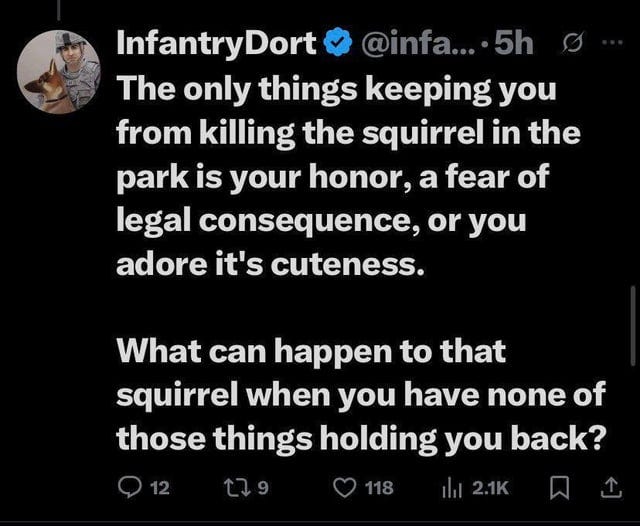
That outrage is the aim is evident in the fact that Greenland’s status has not been a serious question for the better part of a century. The United States made it through the duration of the Cold War without annexing Greenland. After all, as a 1959 report from the State Department said, “we are permitted to do almost anything, literally, that we want to.” Since then, there has not been even a purported change in the strategic situation that suddenly makes the acquisition of Greenland necessary, only the petulant insistence that “we need it.” There has been no coherent argument for this policy, being defended only reflexively out of either sheer partisanship, or being defended because the lie itself is gratifying—again, the logic of the flasher—an exercise of power through bald-faced lying. Stubbornly insisting on something in the face of all evidence is a form of power, or at least a way to feel powerful. Senseless though it is, it is sufficient to provide the thrill.
These people desire outrage, but they also do things that deserve it, from a strategic, moral, legal, and even religious perspective. How might we avoid playing an unwilling part in their self-gratification? In the long term, denying them power is the answer. In the short term, knowledge of their motivations allows us to at least understand their actions and to deny them the thrill they get from our outrage. Cold contempt serves us just as well.
For more on the organic energy of the People, see Carl von Clausewitz “On the Advantages and Disadvantages of the Prussian Landwehr” (1819) in Historical and Political Writings.
See also: Posen, Barry R. “Nationalism, the Mass Army, and Military Power.” International Security 18, no. 2 (1993): 80–124.
Better than contempt, which is an emotional reaction, greet them with indifference. They are trying to provoke an emotional reaction, but don't give it to them. Just state calmly, "It will be the pleasure of the next sane American administration to give Greenland backed to the people to whom it belongs with just compensation."
Psychologically astute point, extremely wittily made.